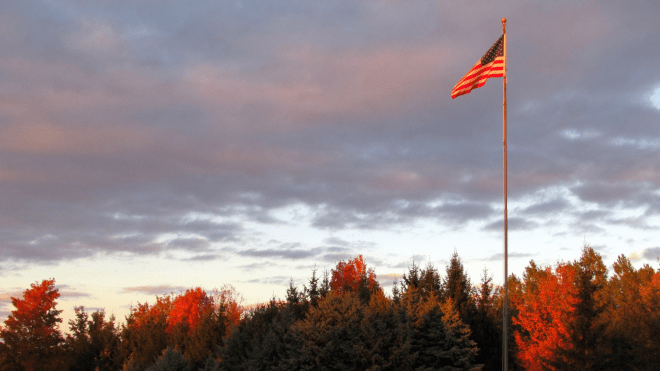
“And so here we are, many of us today: dual citizens. Citizens of the United States of America, and citizens of the kingdom of God. Each is a blessing. Each is a calling. But they are not the same. As a mother and as a pastor, I know what it is to have related and yet separate callings. There are times when being a mother makes me a better pastor; there are times when being a pastor makes me a better parent. They are mutually supportive vocations. I wish the same thing for each of us, in our calling as Christians and our calling as Americans.”
Sermon Preached: Sunday, June 14, 2026 at Trinity on the Green
Proper 6a: Exodus 19:2-8a | Psalm 100 | Romans 5:1-8 | Matthew 9:35-10:8(9-23)
The harvest is plentiful, but the laborers are few. May I speak in the name of God who is to us Father, Son, and Holy Spirit. Amen.
Today at Trinity we begin a five part sermon series called America, America. Our summer sermon series invites preachers to engage with the 250th Anniversary of the United States of America, reflecting on our American identity in light of our Christian faith, and the authors of books who have shaped our understanding of what our country is, and what it can be. The book that I will be reflecting on today is Broken We Kneel: Reflections on Faith and Citizenship, by Diana Butler Bass. But before I get to that book, I want to spend some time with words that we are all accountable to, as Christians– the words of Holy Scripture, as heard today from the Gospel of Matthew.
The harvest is plentiful, but the laborers are few.
These are the words that Jesus tells his disciples on the threshold of their ministry. These words have resounded throughout history for Christians who have found their salvation in the Gospel of Jesus Christ, and have sought to share that Good News with others. These words have carried a different kind of baggage throughout history, and there is something in them that rings particularly true for the American experience.
The harvest is plentiful, but the laborers are few. I think of the earliest European settlers, who brought with them Bibles, a hardy work ethic, and a desire to cultivate a land that seemed to them as fresh and new as the Garden of Eden.
The harvest is plentiful, but the laborers are few. I remember the many laborers who were made to work against their will, both enslaved Africans and indigenous people whose lives were forever disrupted and cut short.
The harvest is plentiful, but the laborers are few. I think, again of hope: the centuries of immigrants who made the journey to the United States for a better life, travelling through ports like New York City, San Francisco, and other places– factory workers, farmers, plumbers, and prospectors.
The harvest is plentiful, but the laborers are few. I think of Uncle Sam and Rosie the Riveter, and the call to people in this country to work and fight for the freedom and safety that we hold dear.
The harvest is plentiful, but the laborers are few. I think of those immigrants today who are the symbolic descendants of the earliest immigrants who came to this country. Immigrants who are eager to work, and wonder if the promises of our Declaration of Independence still hold true: life, liberty, and the pursuit of happiness.
The harvest is plentiful, but the laborers are few.
What harvest are you working for today? What harvest are we working for today– as a church, as a city, as a community, as a nation?
There are still harvests of wealth to be found in these United States. Harvests of real estate and job markets and personal gain. There are harvests of fame– harvests that people dedicate their lives to through daily and hourly posts on social media. There are harvests of technological progress. There are harvests of cultural enrichment– you only have to head outside our doors this week to see the Arts & Ideas festival, a reminder of all the riches of the arts and diversity in our United States of America. And there are harvests of friendship and social connection. Harvests of adventure and experience.
And yet, as Christians it is important to remember that the harvest that Jesus calls us to is none of these things. The harvest that Jesus calls us to is not wealth, or progress, or fame. The harvest that Jesus calls us to isn’t simply beauty or relationships– though those things may be a part of it.
The harvest that Jesus calls us to is this: it is the Kingdom of Heaven. It is God’s vision of a world transformed into the Kingdom of God. And so Jesus calls his disciples, proclaiming that “the kingdom of heaven has come near.” He calls them by name and reminds them: The harvest is plentiful, but the laborers are few. “The Kingdom of heaven has come near.”
How do we understand that Kingdom of Heaven? There are many Christians who have thought that the Kingdom of Heaven is a political entity, here on earth. This belief goes back to the Roman Empire, when the 4th century Emperor Constantine converted to Christianity and made it the state religion. In a similar vein, many Americans have felt that the destiny of the United States and the Kingdom of Heaven are inextricably yoked. People have made life-altering decisions– people have gone to war on the premise that the United States of America and the kingdom of God are one and the same.
But the United States is not the Kingdom of God. It never was, and it never will be. To conflate the two does a disservice to American patriotism, as much as it does to our Christian faith. I am American, and I am Christian– but these are not the same thing. How can I live fully into both of these callings? What is the relationship between being American and being Christian? These are questions that Diana Butler Bass explores deeply and faithfully in her book Broken We Kneel.
Broken We Kneel was written in the years following the September 11 terrorist attacks. This was a time when faith and civics drew close to one another, as people processed the trauma and grief of a world forever changed. And yet for some people, Bass included, the loudest narrative of patriotism did sit easy with her Christian faith. Bass remembers feeling conflicted about a sign that someone put outside of her Episcopal church following 9/11. The sign read: United We Stand. For Bass, that sign felt like tacit approval of a war that was at odds with her faith, a faith rooted in the holiness of every person and the blessedness of peace. Bass imagined a different kind of sign, as she made this proposal to her priest at the time: “I’m going to start the Broken We Kneel campaign. Not a flag. Flags are about victory. A cross. After all, that is what the New Testament teaches. Love our enemies. Pray for them. Pray for forgiveness of our own sins. Broken We Kneel” (Bass 39). Bass was surprised when her priest did not respond to her proposal with the same enthusiasm.
Throughout her book, Bass recognizes that the relationship between faith and civics is more complicated than what words we put on a sign. Each chapter grapples with different themes and topics– from national songs and hymnody, to homeland security. It is surprising how many of her reflections are still relevant today. The 2019 edition of the book includes a new Introduction and a new Epilogue, both of which draw even more explicit connections between the wound of 9/11 and the brokenness we still experience in the United States today. Bass recognizes that we need both United We Stand and Broken We Kneel, applied in faithful ways, as we navigate the complicated relationship between our American identities and our faith.
One of the most helpful concepts for me, throughout the book, is Bass’s frequent reminder that the City of God and the City of Man are not the same thing– in other words the United States of America is not the Kingdom of God. Bass builds on the theology of Augustine of Hippo, the 5th century North African bishop whose entire life and ministry were overshadowed by the Roman Empire. Both Augustine and Bass maintain that earthly cities and the heavenly city may share some hopes and interests in common– and yet, ultimately, our earthly cities and the heavenly city are fundamentally out of sync with each other. Bass describes this as a kind of “dual citizenship.” “I am both a Christian and an American,” Bass writes, “That is not an easy thing these days” (Bass 157). While that dual citizenship is at times problematic and vexing, it is also a gift. Her commitment to both of these identities is clear in the care and attention that are woven throughout this book.
And so here we are, many of us today: dual citizens. Citizens of the United States of America, and citizens of the kingdom of God. Each is a blessing. Each is a calling. But they are not the same. As a mother and as a pastor, I know what it is to have related and yet separate callings. There are times when being a mother makes me a better pastor; there are times when being a pastor makes me a better parent. They are mutually supportive vocations. I wish the same thing for each of us, in our calling as Christians and our calling as Americans. May our Christian faith strengthen us to be better Americans– with our faith guiding us in the ways of peace, inspiring us to see the image of God in every person that we meet. And may our American identities strengthen our faith, so that we may be blessed and challenged by people who look and think differently than we do, yet are compelled by the same unalienable rights named in our Declaration of Independence 250 years ago: life, liberty, and the pursuit of happiness.
The harvest is plentiful, but the laborers are few.
Will you work with me, to support a healthier, more whole relationship between our Christian faith, and this country we call home? I hope that you will.
But I also hope that you and I will remember, at the end of the day, that we are called first and foremost to be citizens of the kingdom of God. We are called to be citizens of a kingdom that is always emerging, always reorienting itself around an essential and eternal center– and that center is the Love of God. In her expanded epilogue, Diana Butler Bass asks: “What if Christians were not afraid of Jesus’ politics of love? His partisanship for the least of these?” (Bass, 176). These questions inspire me to be more like Christ, insofar as that is possible in this human flesh. These questions remind me that faith is not simply about belief, but also how those beliefs change how we live and move in the world.
The harvest is plentiful, but the laborers are few.
I hope you will walk alongside me, with dust on our feet like the disciples, close to the ground where Jesus himself walked. Cure the sick, feed the hungry, cast out the demons of pride and tribalism and self-interest that forever haunt us. Walk beside me, as we set our destination as the Kingdom of Heaven, keeping the teachings of Jesus as our guide. Bowing our heads when we recognize the ways that we have fallen short. Bowing our heads to pray for the courage to live differently. Bowing our heads to pray for friends and enemies, and everyone in between. I hope you will walk beside me; I hope you will kneel beside me– as citizens of the kingdom of God. Amen.
Works Cited
Bass, Diana Butler. Broken We Kneel: Reflections on Faith and Citizenship. San Francisco: Jossey-Bass, 2004.

