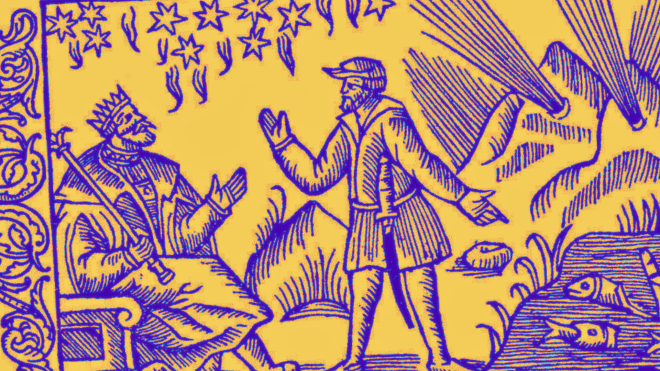
“All of us are vessels, holy containers of the spirit of God– and we shall prophesy, as the scripture says. For those of us who aren’t trained in the prophetic ways of the Oracle of Delphi, or prone to ecstatic visions, it’s worth asking what this means. What does it mean to prophesy? What does it mean to be a prophet today?”
Sermon Preached: Sunday, May 24, 2026 at Trinity on the Green
Pentecost, Year A: Acts 2:1-21 | 1 Corinthians 12:3b-13| John 20:19-23
Between the words that I speak and the words that are heard, may God’s Spirit be present. Amen.
When I say prophecy, what is the first thing you think about? What words or images; what examples come to mind? Prophecy.
The ancient Greeks and Romans had their prophets. Generations of Greeks would travel to the Oracle of Delphi for insight from an ancient lineage of priestesses, called the Pythia. The Roman version of a similar kind of prophecy put faith in the Sibyls, a group of mystic prophetesses who spoke truths in ecstatic visions, which were later written down in verse.
While these examples might sound foreign, it’s helpful to remember that our own spiritual ancestors in the Hebrew and Christian traditions had prophets too– prophets whose words are written down in 17 books in the Old Testament from Isaiah to Malachi. Some of their words have been seen, in retrospect, as predictions of the coming of Jesus. But most of their words spoke to the present realities of the northern kingdom of Israel and the southern kingdom of Judah from 800 to 400 BCE. The prophets urged people to turn away from wrongdoing, and they cast a vision of a better future born from righteousness. As the prophet Micah wrote, “what does the LORD require of you but to do justice and to love kindness and to walk humbly with your God?” (Micah 6:8). Beyond the prophets of the Old Testament, there are other scriptural dabblings in prophecy– from King Saul consulting the Witch of Endor for political advice, to Jesus’ disciples casting lots to determine who would fill Judas’ role as the 12th disciple.
While prophecy of this sort was quite popular in the ancient world, there are more contemporary examples as well. The 16th century French physician and astrologer Nostradamus was legendary for his prediction of future events– from the death of King Henry II in a jousting tournament, to events far in the future such as the rise of Napoleon Bonaparte and Adolf Hitler. Some modern readers of Nostradamus see him foreshadowing events as recent as the Covid-19 pandemic.
Today, there are some people of faith who predict the end times with all the fervor of the ancient prophets, reading the Book of Revelation as if it were an Oracle. Meanwhile, people read their horoscopes with interest, as if to learn something about the future that could anchor us in these chaotic times. One article I read this week about ancient prophecy describes its ongoing relevance in this way: “For as long as humans have worried about tomorrow, they have searched for someone who could see beyond it” (Ponti, Famous Prophecies). Clearly we are still worried about the future, and we are still looking for ways to see beyond it– to see something, anything, beyond this moment.
The examples of prophecy that I have shared might sound strange, extreme, or marginal. Nevertheless, every one of us is called to be a prophet. Every one of us is called upon to prophesy.
In today’s reading from the Book of Acts, we hear the story of Pentecost– the story of how God’s Holy Spirit descended on the disciples, giving them a palpable sense of the presence of God after Jesus’ ascension. When the Spirit descends, like tongues of fire, the disciples begin to speak in other languages– making it possible for strangers throughout the city of Jerusalem to understand, and to be understood. This Pentecost story presents a window into what the kingdom of God looks like. It is not a kingdom of one kind, but rather a kingdom of many kinds of people connected through the Spirit of God.
When the disciples began to speak, what did they say? Peter answers this question, not in explicit terms but in a more general sense, when he addresses the crowd and quotes the prophet Joel with these words:
In the last days it will be, God declares,
that I will pour out my Spirit upon all flesh,
and your sons and your daughters shall prophesy,
and your young men shall see visions,
and your old men shall dream dreams.
Even upon my slaves, both men and women,
in those days I will pour out my Spirit;
and they shall prophesy.
These are the words of God, speaking through the prophet Joel, speaking through Peter to say this: each one of us is a prophet. In these days after the gift of the Spirit at Pentecost, we are all called to be prophets. Like the disciples at Pentecost we too are given visions; we too dream dreams. Because the words that Peter quotes from Joel apply to all of us: sons and daughters; young and old; those people who are enslaved (and God knows there have been many throughout history and even now), and those who are free. All of us are vessels, holy containers of the spirit of God– and we shall prophesy, as the scripture says.
For those of us who aren’t trained in the prophetic ways of the Oracle of Delphi, or prone to ecstatic visions, it’s worth asking what this means. What does it mean to prophesy? What does it mean to be a prophet today?
We have some understanding of “modern day prophets” when we think of those leaders of movements who have stood up for justice. I think of the Rev. Dr. Martin Luther King, Jr., and his stand for civil rights and peace; or Archbishop Oscar Romero, who united and defended the people of El Salvador against its oppressive government. Greta Thunberg is another person frequently cited as a modern prophet, for her climate strike that became a global movement to highlight the crisis of our changing planet, and she continues to use her voice to defend the health and safety of people around the world today, especially people in Palestine. I think it is appropriate and meaningful to understand these people as prophets. And also– if our definition of prophecy is only limited to the loudest, most eloquent, most famous, most infamous among us– then how will we ever be able to see ourselves as prophets too? How will we be able to prophesy?
I suggest that we start simply. Don’t start by putting yourself in a trance; don’t start with predicting the future– in other words, don’t start outside the realm of the gifts that God has given you. Instead, start with two practices that are the hallmarks of prophecy. First: tell the truth. And second: be a bearer of hope to the world.
First, tell the truth. Prophecy is about truth-telling. The Hebrew prophets told the truth about the ways that the Israelites and Judeans had strayed from the word of the LORD. This truth-telling wasn’t necessarily uplifting– actually, it was often scathing. But there is something about the truth that is ultimately healing for the people who receive it. Prophecies from the Oracle of Delphi to modern horoscopes have stood the test of time because they contain a core of truth— whether by accident, observation, broadness, or spiritual insight. We human beings crave truth.
Perhaps for you today, being a prophet means saying something true: something true about the world that we live in; something true about yourself; something true about God. Whatever it is– speak the truth. What you say doesn’t have to be original; it just has to be true. In fact, this exercise of truth-telling is a lot easier when you take off the burden of originality, and instead sink your feet deeply in the roots of our Christian tradition, and the truth we have come to know through Jesus Christ. Speak the truth, and make space for healing. As Jesus says in the Gospel of John: “if you abide in my word you are truly my disciples, and you will know the truth, and the truth will set you free” (John 8:31-32).
Second, be a bearer of hope to the world. Prophecy is by nature a forward-looking practice– sometimes it involves literally telling the future. As prophets, you and I don’t have to claim that we know what will happen tomorrow. But I hope you will proclaim, along with me, the conviction that tomorrow can be better than today. As we say in the Lord’s prayer: Thy kingdom come, thy will be done. Tomorrow can be better than today.
It is the work of prophets to keep hope alive– to keep hope alive, even when our own spirits are flagging. Being a bearer of hope doesn’t mean that you have to be a constant optimist. In fact, hope grows much stronger when it is planted in the soil of struggle; when it comes from people who are well-attuned to how fragile and precious life is. Keep hope alive, and keep proclaiming the kingdom of God– that vision of the world not as it is, but as it could be. And prophecy not only in word but in deed, living the values of the Gospel as if that kingdom were already here.
In the last days it will be, God declares,
that I will pour out my Spirit upon all flesh,
and your sons and your daughters shall prophesy,
and your young men shall see visions,
and your old men shall dream dreams.
Each one of us is a prophet. Each one of us is a frequency that magnifies the voice of God in a way that no other person can. Speak the truth; be a bearer of hope to the world– and allow yourself to be a prophet of the Good News of the Kingdom of God. Amen.
Works Cited:
Ponti, Crystal. Famous Prophecies: From Delphi to Nostradamus. History.com. 24 March 2026. Accessed 21 May 2026. http://www.history.com/articles/famous-fortune-tellers-prophecies-predictions-seers.

