“Do you like my hat? We might ask that question to God, in our own prayer and practice. O God, do you like this life that I have clothed myself in– or are there ways that I still need to change, to grow, to take off the old and put on the new? And we can ask that question of our communities as well: our church, our city, and our country. What garments have we put on?”
Sermon Preached: Sunday, October 11, 2026 at Trinity on the Green, New Haven
Proper 19a: Isaiah 25:1-9 | Psalm 23 | Philippians 4:1-9 | Matthew 22:1-14
Between the words that I speak and the words that are heard, may God’s Spirit be present. Amen.
I’d like to begin my reflections today by reading from one of my favorite books, one of the first books to capture my imagination as a child:
Dog.
Big dog. Little dog.
Big dogs and little dogs.
Black and white dogs.
“Hello!” / “Hello!”
“Do you like my hat?” / “I do not.”
“Good-by!” / “Good-by!”
These are the first few pages of the book Go, Dog. Go! By P.D. Eastman. This book isn’t so much a narrative as it is a description of dogs doing things. Dogs sitting on top of trees. Dogs driving around in cars. Dogs riding a roller coaster. You know– typical dog things. The illustrations are similar to a classic Dr. Seuss book, and children who hear these words learn about opposites: red / green; up / down; stop / go; in / out.
There isn’t really a plot – but there are some through lines in the book. One consistent theme is two dogs, a yellow dog and pink poodle, who encounter each other throughout the book. Each time the pink poodle comes with a different hat and asks the yellow dog, “Do you like my hat?” And each time, up until the very end, the yellow dog answers, “I do not.” Goodbye– Goodbye. They say to each other. And the book goes on.
The other theme of the book, so to speak, is cars and other vehicles. Who knew dogs love driving cars so much? At the end of the book the dogs are driving in a line of cars, fast. The book asks us these questions:
Why are they going fast in those cars?
What are they going to do?
Where are those dogs going?
You can feel the suspense building as the dogs drive towards a tree. They get out of their cars. They climb up a ladder to the top of the tree. Will they work there? Will they play there? What is up there on top of that tree? The book asks.
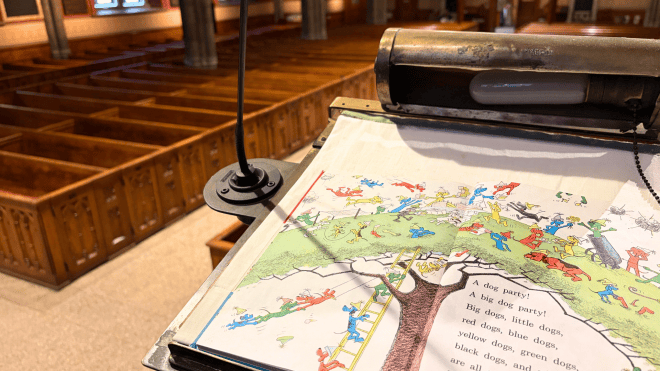
The answer: A dog party! A big dog party! Big dogs, little dogs, red dogs, blue dogs, yellow dogs, green dogs, black dogs, and white dogs are all at a dog party! What a dog party!
The yellow dog and the pink poodle meet each other one last time– both of them wearing extravagant hats on their heads. The pink poodle asks if the other dog likes her hat, and finally, blessedly he replies in the affirmative: I do. What a hat! I like it! I like that party hat!
Good-by. The text says. Good-by. And together they drive off into the sunset.
The End.
I hope that summary has sufficiently introduced you to the book Go, Dog. Go! Or perhaps reacquainted you with an old friend. It’s a bit of a difficult book to explain– not because it is complicated, but because (like so many children’s books) it is simply very weird. But this weird story is one of the first things I thought of this week when I read again another weird story– the parable of the king and the wedding banquet, that we heard as our Gospel reading for today. Both stories involve a party, and it’s that similarity (among others) that I’ve been reflecting on this week.
In the parable, a king decides to give a wedding banquet for his son. And from there, everything goes wrong. The king sends his slaves to call those who have been invited to the wedding banquet, but no one wants to come. Even worse, some of those who have been invited are threatened, abused, and killed by those who would be guests. The king retaliates, sending troops to destroy the murderers and burn their city. Somehow, the king is still trying to make the wedding happen– so he sends his slaves out into the streets to invite anyone and everyone to the wedding banquet, good and bad, until the wedding hall is filled with guests.
But then, the tone of celebration shifts. The king arrives to find a man who is not wearing a wedding robe. The man is questioned. He is speechless. The king tells his attendants to throw the man out “ ‘into the outer darkness, where there will be weeping and gnashing of teeth.’ For many are called, but few are chosen.”
What a strange, and intimidating parable this is.
What can we learn about the kingdom of heaven from these words? What can we learn about that kingdom that we, as Christians, profess and long to make a reality here on earth?
In a way this parable has two themes– two themes which are surprisingly parallel to the themes in P.D. Eastman’s Go, Dog. Go! The first is a theme of radical welcome. And the second is a theme of serious responsibility.
We see the theme of radical welcome when the king tells his slaves to go out into the streets, and invite everyone and anyone to join the celebration. It’s as if the kingdom is a big dog party taking place on top of a tree– a party where there are big dogs, little dogs, red dogs, blue dogs, yellow dogs, green dogs, black dogs, and white dogs. What a dog party! Perhaps this is why that final image, the dog party on the top of the tree, stood out to me so much as a child. I loved the idea of that party. I loved the joy, the playfulness, the welcome of that party. Surely that is what the kingdom of God looks like. Elsewhere in the Gospels Jesus says that the kingdom of heaven is like a mustard seed that grows into an enormous tree, a tree that is big enough for all the birds of the air to nest in its branches (Matthew 13:31–32, Mark 4:30–32, Luke 13:18–19). Whether it’s birds nesting, or dogs partying– this is what the kingdom of God looks like: a tree, an organic thing that has grown tall and wide and deep and there is room for everyone in the embrace of that tree’s branches.
And then there is that second theme– the theme of responsibility. This is the theme that we encounter in the parable when the king meets a man who is not wearing wedding robes, and orders him to be cast out. This scene feels at odds with that other vision of the kingdom of heaven as a place of radical welcome. And yet I think this scene is an important reminder that following Christ is not simply an incredible gift; it also comes with great responsibility. When we follow seriously in the path of Jesus Christ we are changed. Our lives our transformed by the promises we make– promises to repent, when we do wrong; promises to love God above all else, and to love our neighbors as ourselves.
This transformation reminds me of the pink poodle, and her seemingly endless collection of hats. Do you like my hat? She asks, again and again. And the yellow dog answers with crippling honesty, I do not, again and again. We might question whether the yellow dog’s approval was really that important, in the context of Go, Dog. Go! But in terms of our faith, we know that God’s approval is important– not because we are self-conscious children, but because God truly wants what is best for us. Christ is our compass, leading us to all that is good and holy and true. As Christians, we want to be transformed into the people God knows that we can be; the best version of ourselves. As Christians, we are told to take off our old self, like a piece of old clothing, and put on our new self, the true sense of self that we find in Christ. The apostle Paul writes, in his letter to the Colossians, “Do not lie to one another, seeing that you have stripped off the old self with its practices and have clothed yourselves with the new self, which is being renewed in knowledge according to the image of its creator” (Colossians 3:9-10). I believe this spiritual clothing is what Jesus is talking about in the parable of the king and the wedding banquet. The man at the end of the wedding banquet is not being thrown out for some superficial reason. He is thrown out because he has seen the gifts of the kingdom of God, but he has not been changed. He has not allowed himself to be changed by the grace and love of God.
Now speaking of that grace and love, I am someone who believes that ultimately there is nothing we can do to separate us from the love of God (Romans 8:38). And also, I believe that we can be changed– we will be changed– when we embrace Christ as our Savior; our way, our truth, and our life.
Do you like my hat? We might ask that question to God, in our own prayer and practice. O God, do you like this life that I have clothed myself in– or are there ways that I still need to change, to grow, to take off the old and put on the new? And we can ask that question of our communities as well: our church, our city, and our country. What garments have we put on? What garment have we put on, when our government has proposed a livestreamed execution in response to a horrible act of violence, retaliating an eye for an eye? Is that garment of Christ, or that the garment of fear and death? The Presiding Bishop of our Episcopal church, the Most Rev. Sean Rowe, offered this statement earlier this week: “The Episcopal Church has long formally opposed the death penalty, and more recently we have called for an immediate moratorium on its use…. The idea of live-streaming a firing squad execution is reprehensible in the extreme and will cause moral injury to everyone involved. We need to ask ourselves who we have become as a nation when senior officials decide to make a spectacle of state-sponsored violence.” I invite you this week to pray about our decisions as a country, in regards to the death penalty, and to take action if you feel called to do so. But we don’t have to linger on big, conflictual issues before we ask ourselves this question: God, do you like my hat? Do you like this self that I have put on. Do these garments reflect your love, your justice, your mercy?
Wonder, in specific ways, about the changes that God is inviting you to make– in the hats that you wear; in the way that you live. And let yourself be changed. Because the kingdom of God is worth it. What a party it is. (What a big dog party!) What a vision of grace, and diversity, and joy, and love. May you never cease working towards the kingdom of heaven. Work towards the kingdom of heaven, as it lives in you. Work towards the kingdom of heaven, as it lives beyond you. Work towards the kingdom of heaven, in the name of the Father, and the Son, and the Holy Spirit. Amen.

